

Commercial & residential · Houston, TX
Polished Concrete Floors in Houston.
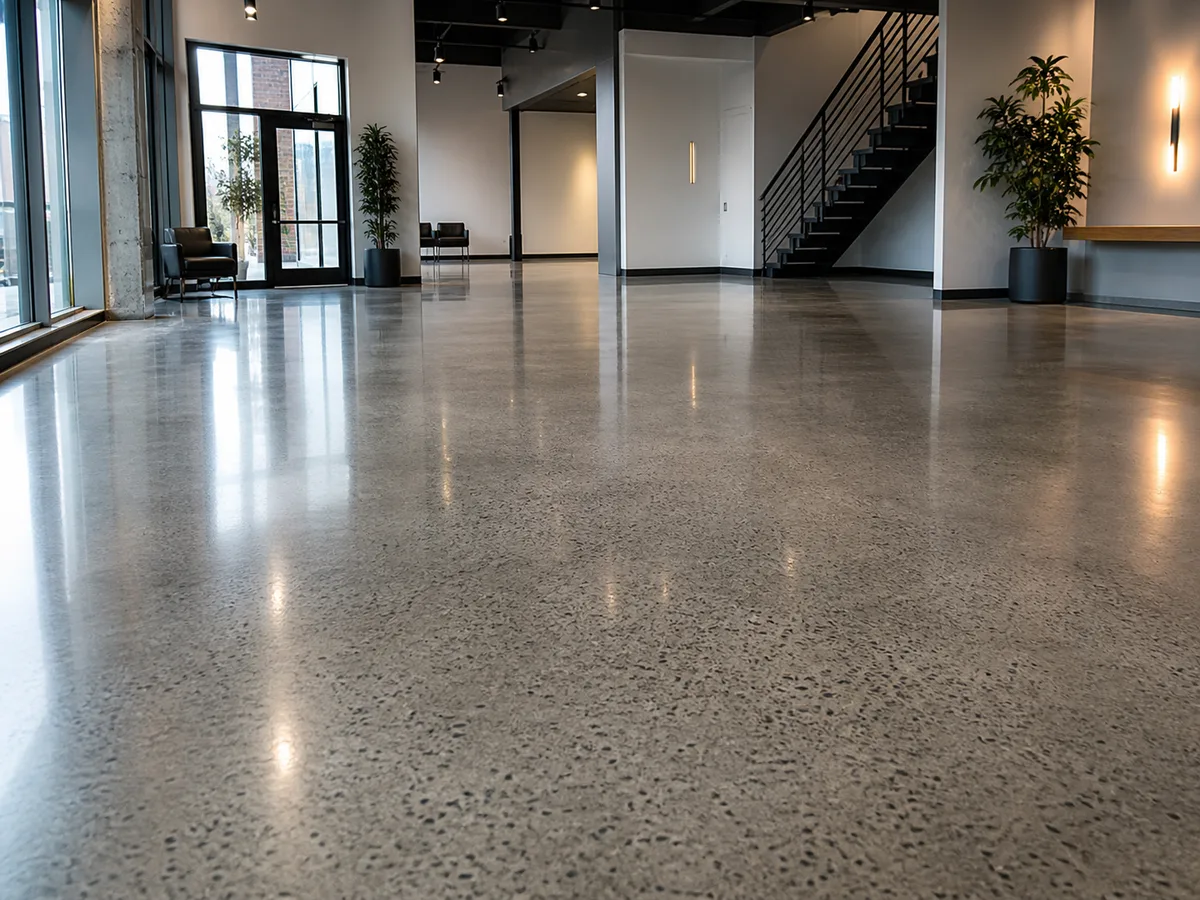
Multi-step diamond grinding that densifies and burnishes the concrete itself: no film, no topcoat, no layer to peel or chip. A harder, more reflective surface that handles heavy commercial traffic. Starting at $3/sq ft.
- 5.0 across every Google review
- 5-year installation warranty
- Multi-step diamond process
- Starting at $3/sq ft
- Houston-owned
The short answer
Polished concrete isn’t a coating. It’s the concrete itself, refined. Diamond tooling grinds through successive grits to create a surface that’s denser, harder, and more reflective than the original slab. The result is a floor with no film to delaminate, no topcoat to reapply, and a finish that’s common in commercial warehouses, retail showrooms, and restaurants across Houston. Starting at $3/sq ft ($0.50 per step, minimum 4 steps). $1,500 project minimum.
01 · What it is
You’re not covering the concrete. You’re perfecting it.
- No film layer. No topcoat. Unlike epoxy or polyaspartic, polishing doesn’t apply anything on top of the concrete. Diamond tooling removes material, progressively refining the surface until it’s dense, hard, and reflective. The concrete becomes the finish.
- Densifier hardens the concrete itself. At the mid-point in the process, a penetrating chemical densifier is applied. It reacts with the calcium silicate in the concrete, permanently increasing hardness and reducing porosity. A densified slab resists moisture, staining, and abrasion far better than untreated concrete.
- Nothing to delaminate, peel, or chip. Coatings fail at the interface between the product and the concrete. Polished concrete has no interface. The finish is the concrete. Forklift traffic, heavy equipment, and chemical exposure that would destroy a coating leave polished concrete unmarked.
- Matte to high-gloss. Your choice. The final sheen level is controlled by how many steps we run and how fine the final grit. More steps = higher gloss. We’ll recommend the right level for your space and use case.
- Reduces lighting costs in commercial spaces. A reflective polished concrete floor acts as a light multiplier. Studies have shown lighting energy costs in large commercial facilities can drop significantly because the floor bounces ambient light back into the space rather than absorbing it.
- Allergy-friendly. Nothing to trap dust or pollen. Unlike carpet or tile grout, polished concrete has no fibers or crevices where allergens accumulate. The surface cleans completely with a damp mop. No residue left behind.
02 · How we do it
How we polish concrete: the grit-by-grit process.
Each step uses progressively finer diamond tooling to remove the scratches left by the previous step. More steps = finer surface = higher gloss. Most commercial projects use 4–6 steps. Price is $0.50/step. More steps add gloss and durability.
Step 1: Coarse grind
30–50 grit metal-bond diamonds. Opens the concrete, removes surface damage, lippage, and high spots. Exposes the aggregate profile. Heavy material removal. The floor looks rough at this stage. That’s correct.
Step 2: Medium grind
100–200 grit. Removes the deep scratches from Step 1, begins to close the surface. Aggregate becomes visible and consistent. The floor starts to look intentional. Transition from metal-bond to resin-bond tooling.
Step 3: Fine grind + densifier
400 grit resin-bond. Densifier applied at this stage. It penetrates the concrete and reacts with calcium silicate to permanently harden the surface. After densifier cures, the floor is significantly more resistant to abrasion and staining than raw concrete.
Step 4+: Honing & burnishing
800–3,000 grit. Each pass removes the scratch pattern from the previous. Final burnishing produces the finished gloss level, from satin (800) to high-gloss mirror (3,000+). Most commercial jobs stop at 800–1,500. Showrooms and retail typically go to 3,000.
Pricing: $0.50 per step. Minimum 4 steps (starting at $3/sq ft). Additional steps add gloss and durability. $1,500 project minimum.
03 · Best for
Built for commercial floors. Available for any concrete.
Polishing is the right call when…
- Warehouses, distribution centers, manufacturing
- Retail showrooms & auto dealerships
- Restaurants & hospitality spaces
- Office lobbies & commercial interiors
- Residential garages & living spaces (available)
- High-traffic areas where coatings would delaminate
- Anywhere you want the natural concrete aesthetic
Consider other systems when…
- The slab is heavily damaged or spalled: resurfacing first
- You want solid color or decorative flake: see epoxy or decorative flake
- You want translucent stain color: see staining & sealing
- You want a modern seamless overlay: see microcement
- Chemical resistance is critical (commercial kitchens): epoxy or polyaspartic may be better
04 · Honest limitations
What polished concrete doesn’t do well.
We’d rather tell you now than have you find out later. Polished concrete is the right call for most commercial floors. But it has real trade-offs worth understanding before you commit.
Acoustics
Hard surfaces reflect sound. A large open space with polished concrete will echo more than carpet or acoustic ceiling tile. Most warehouses and retail stores manage fine. The tradeoff is worth it. But for open offices, restaurants, or spaces where noise matters, plan for acoustic panels, rugs, or soft furnishings to absorb sound.
Temperature
Concrete floors are colder than carpet, hardwood, or cork. In Houston’s climate this is rarely a problem outdoors and often a bonus in summer. For residential living spaces, it’s worth knowing. Radiant heating in the slab solves this completely. It’s worth specifying if you’re building new and cold floors are a concern.
Porosity & spills
Polished concrete is denser than raw concrete, but it’s not impervious. Oils, acids, and dark liquids left sitting can stain. The densifier and guard products applied during polishing reduce porosity significantly. But this is not a topically sealed, fully impermeable surface. Wipe up spills promptly and the floor will perform.
Not always the cheapest option
A persistent myth: polished concrete is the most cost-effective flooring available. The process (multiple grinding passes, densifier, and finishing) is typically comparable in price to other quality flooring systems. On damaged or contaminated slabs, prep work adds cost. The advantage is lifetime maintenance cost, not upfront price.
05 · Setting expectations
90% of polished concrete complaints have nothing to do with the polishing contractor.
Concrete is an industrial material. It is never going to be perfectly uniform, and the finished result is always a function of what the slab was before we arrived. We communicate this upfront, not as an excuse, but because it leads to better outcomes for everyone.
Newly poured slabs
- Construction sites are active environments. Scissor lifts leak hydraulic fluid. Crews spill coffee, solvents, curing compounds. All of these can affect how the concrete accepts a polish.
- Inconsistent troweling matters. If the field of the slab was power-troweled to a different hardness than the edges (which happens frequently on large pours), the finish can vary across the slab.
- The design mix matters. Polished concrete should be specified by the architect or engineer with a proper concrete mix for the contractor pouring the slab. Especially important for integrally colored concrete.
Existing & refurbished slabs
- Color and tone are dictated by the original sand-cement ratio of that specific pour. We cannot change the underlying color. We can only reveal and enhance it.
- If there was tile on the slab, there is a very high probability of tile ghosting: a grid pattern visible in the finished surface where grout lines sat. This can be overcome with an overlay at additional cost; we will tell you if we see this risk during evaluation.
- Patches, trenches, and repaired areas will show. Polishing does not hide prior repairs. In some cases it makes them more visible. We evaluate this before quoting so there are no surprises.
The best polished concrete outcomes come from good communication before work starts, between the owner, the contractor pouring the slab, and the polishing crew. We’re happy to be part of that conversation early.
06 · Decision
Polished concrete vs. epoxy or polyaspartic coatings.
The most common question in commercial floor jobs. Here’s how to think about it.
- No delamination risk. Coatings bond to concrete. Under heavy impact, forklift traffic, or moisture from below, that bond can fail. The coating peels or blisters. Polished concrete has no bond to fail. It’s the same material all the way through.
- Natural concrete look. Polishing enhances and reveals the concrete: aggregate, color variation, character. Coatings cover it with a uniform color or decorative system. If you want the natural look: polish. If you want color or decorative design: coat.
- Lower long-term maintenance. Polished concrete needs occasional re-burnishing under heavy commercial use. Coatings eventually need re-coating as the film wears. Over a 15–20 year period, polished concrete typically has lower total maintenance cost.
- Coatings are easier to repair spot-by-spot. If one section of a coated floor gets damaged, that section can be re-coated independently. Polished concrete repairs are more complex because matching the surrounding sheen level is difficult.
Want a coating instead? See our epoxy garage floor coatings and polyaspartic floor coatings.
07 · Warranty
Backed by a 5-year installation warranty.
Every polished concrete installation by Houston Floor Coatings is backed by a 5-year installation warranty. If our workmanship or process causes a failure, we come back and make it right.
Standard exclusions: physical damage, impact, structural cracks or concrete movement, alterations by others. Polished concrete is a durable, low-maintenance system. With proper care, it regularly outperforms its warranty by decades. Full warranty terms.
08 · FAQ
Polished concrete floor questions.
How long does polished concrete last?
Polished concrete is one of the most durable floor finishes available. In commercial environments with proper maintenance, 20–30 years is typical. There’s no film to wear through. When the gloss diminishes under heavy traffic, a maintenance buff restores it without grinding back to bare concrete. Polished concrete in lightly-used spaces often looks as good at 30 years as it did at installation.
Can you polish any concrete floor?
Most concrete in good structural condition can be polished. Slabs that are heavily spalled, have deep cracks, or have significant surface contamination (old adhesive, paint, asphalt) require prep work first. We evaluate the slab before quoting and will tell you up front if polishing is the right fit or if prep is needed first.
Is polished concrete slippery?
Dry polished concrete has slip-resistance similar to polished tile. That’s acceptable for most commercial and residential applications. Wet polished concrete can be more slippery than a coated floor with broadcast aggregate. For wet environments (commercial kitchens, pool surrounds), we’d typically recommend a floor with a non-slip additive or a different system. We’ll flag this if it applies to your space.
How much does polished concrete cost in Houston?
Starting at $3/sq ft for a 4-step polish. Each additional step adds $0.50/sq ft and increases the gloss level. $1,500 project minimum. Final price depends on slab condition, square footage, and target gloss level. Get a ballpark estimate in 2 minutes.
How long does the polishing process take?
A 4-step polish on a clean, well-prepared commercial floor typically takes 1–2 days for 2,000–4,000 sq ft. Larger spaces or more steps take proportionally longer. The floor is fully walkable as soon as we’re done. No cure time required, unlike coating systems. Most commercial clients schedule work overnight or over a weekend to minimize downtime.
Do you polish residential floors or just commercial?
Both. Commercial polishing is more commonly requested. Warehouses, showrooms, and restaurants represent most of our polishing volume. But we also polish residential concrete: living rooms, basements, and garage floors where the homeowner wants the natural concrete aesthetic without a topical coating. Minimum project size applies.
Will my polished concrete floor look perfect?
Polished concrete has a natural, industrial character. It’s not a manufactured product with a factory-consistent appearance. The result depends heavily on what the slab was before we started: mix design, pour quality, troweling consistency, contamination history, and prior repairs all show in the finished surface. On a well-placed, uncontaminated slab the results are exceptional. On a compromised slab they can be inconsistent. We evaluate the slab before every project and tell you honestly what to expect, including risks like tile ghosting on refurbished floors or color variation on patched areas. We’d rather walk away from a job than deliver a result that disappoints.
Does polished concrete help with lighting costs?
Yes. This is a real and underappreciated benefit for commercial spaces. A high-gloss polished concrete floor acts as a reflective surface, bouncing ambient light back into the room rather than absorbing it. In large facilities (warehouses, distribution centers, retail stores), this can meaningfully reduce how hard your lighting system has to work. Some national big-box retailers cite polished concrete as a factor in their lighting efficiency. It’s not the primary reason people choose polished concrete, but it’s a genuine ROI component for large commercial clients.
Related services
Other concrete systems we install.
Ready to polish your concrete floors?
Free online estimator gives you a ballpark in 2 minutes. On-site estimates are $50, credited to your project if you book. For commercial jobs, call us. We’ll schedule a site visit, assess the slab, and walk you through step count and gloss options before you commit to anything.
Service area