

Houston’s most-requested coating service
Garage Floor Coatings in Houston.
Professional epoxy garage floor coatings installed across greater Houston. Three finishes (speckled, solid color, and marbled), each backed by a 15-year written installation warranty. Priced flat by garage size.
- 5.0 across every Google review
- 15-year installation warranty
- 2-day install, drive on it day five
- Fully insured
- Houston-owned
The short answer
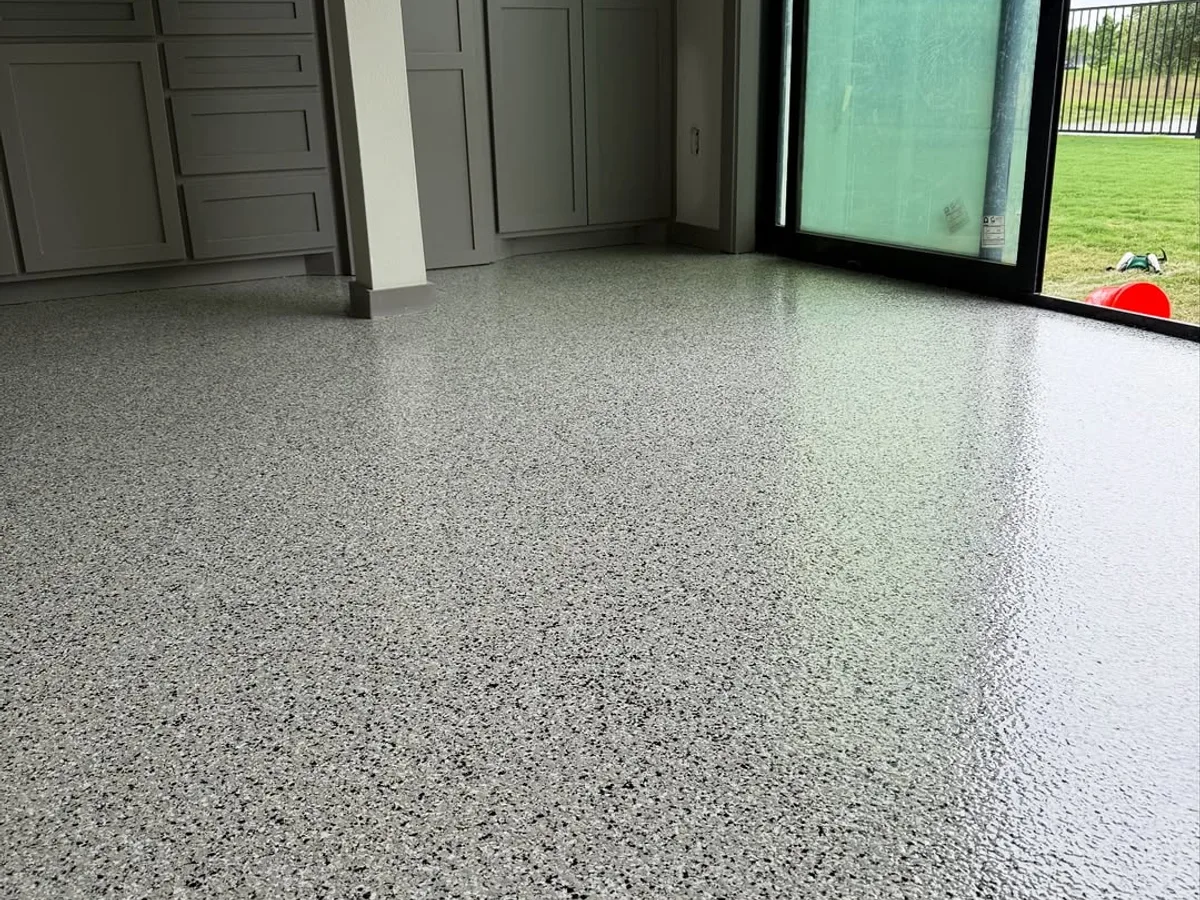
A garage floor coating is a multi-layer system applied directly to bare concrete that seals the slab from oil, chemicals, hot tires, and Houston’s humidity, while transforming the space visually. We install three finishes: speckled (our 2-day epoxy hybrid with full flake, the flagship), solid color (three-coat neat), and marbled (decorative metallic). Every system uses a real epoxy primer (not a single-product shortcut) paired with a UV-stable polyaspartic topcoat. 15-year installation warranty in writing on every install. Garages are priced flat by size. Flat by garage size in speckled.
01 · Why it matters
Why Houston homeowners coat their garage floors.
Bare concrete in a Houston garage is a problem waiting to happen. Here’s what drives most clients to pick up the phone:
Concrete absorbs everything
Uncoated concrete is porous. Oil drips soak in permanently. Spilled chemicals etch the surface. Moisture migrates up through the slab in Houston’s humid climate. A sealed coating system locks all of that out: spills wipe up instead of soaking in, and moisture can’t find a path through.
Houston’s heat destroys inferior finishes
Slab surface temperatures above 100°F in summer, combined with year-round humidity, cause expansion and contraction cycles that crack cheap coatings and peel DIY epoxy kits. A proper coating system (100% solids epoxy base + polyaspartic topcoat) is engineered for thermal cycling and humidity. It lasts; the kits don’t.
Hot tires lift unprimed surfaces
When you park a car that’s been running in Houston summer heat on a surface that wasn’t properly prepped and primed, the contact zones can lift the coating right off the concrete. That’s hot-tire pickup. It’s why surface prep matters more than the product.
The space transformation is real
A coated garage floor changes how you use the room. Grey cracked concrete becomes a polished, seamless surface that reflects light and holds up to decades of daily use. Clients move their workshop in, finish the walls, add cabinets, all because the floor made the space feel worth investing in.
Home value goes up
A professionally coated garage is a visible, verifiable upgrade buyers notice and value. It signals a maintained home, not a deferred one. Unlike most home improvements, a coated floor is immediately obvious to anyone who opens the garage door.
It’s permanently dustproof
Concrete sheds fine dust constantly: it settles on your car, your tools, your stored boxes. A sealed coating system stops concrete dusting at the source. The surface is hard, impermeable, and easy to clean with a mop or leaf blower.
02 · Our systems
Four coating systems. One right answer for your garage.
Every system uses a real epoxy primer (not a single-product shortcut) and a UV-stable polyaspartic topcoat. The difference between them is primer cure time, install schedule, and price point.
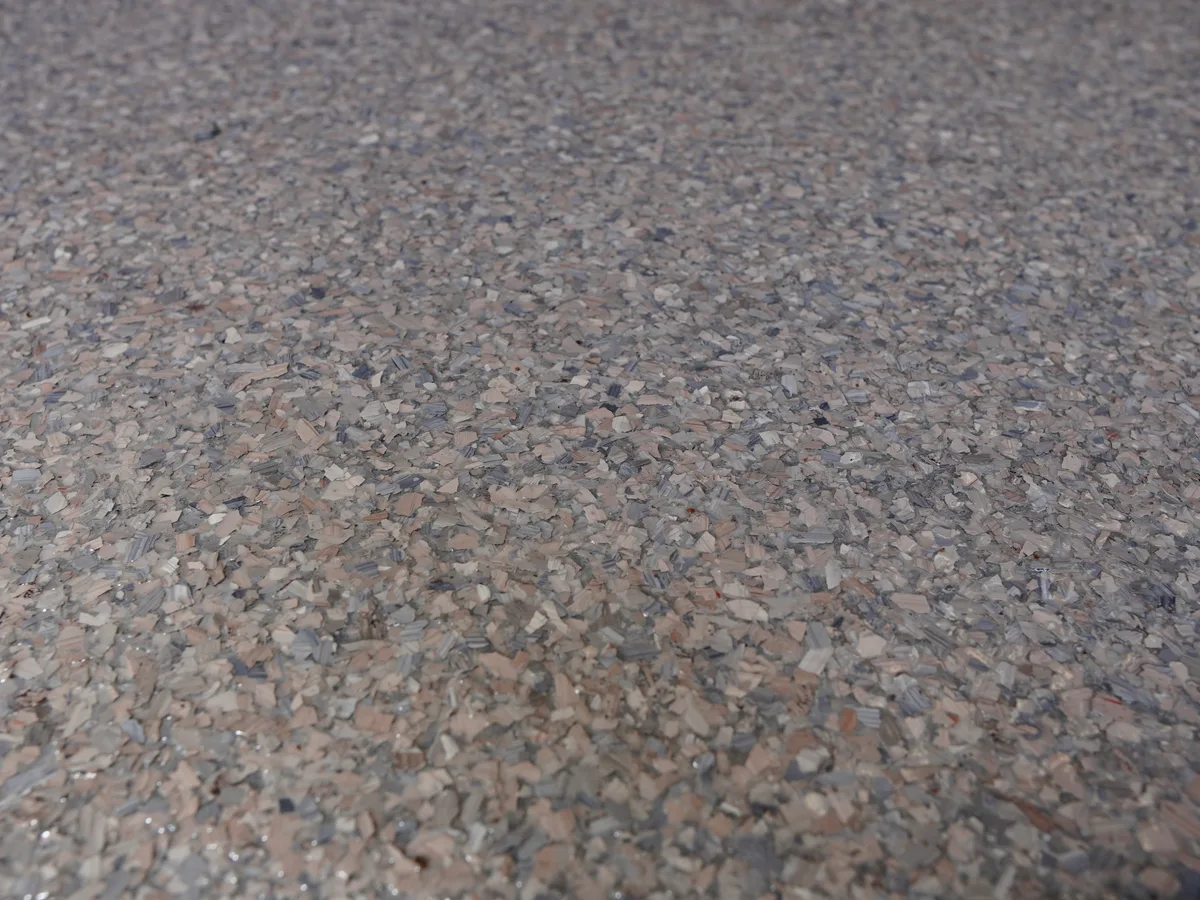
2-Day Epoxy Hybrid
Standard-cure 100% solids epoxy primer cures overnight before the topcoat goes down. That’s the deepest bond we build. Full-refusal vinyl flake broadcast in 16 blends. UV-stable polyaspartic topcoat. The system most Houston clients choose when timeline isn’t a constraint.
Solid Color: Three-Coat Neat
One clean color, no flake, no marbling: the look of a marbled floor without the swirl. Three coats laid flush and seamless, finished in high gloss or matte. It costs more than speckled because it takes more material: with nothing to conceal the slab, the holes and low spots get filled first. Three to four install days.
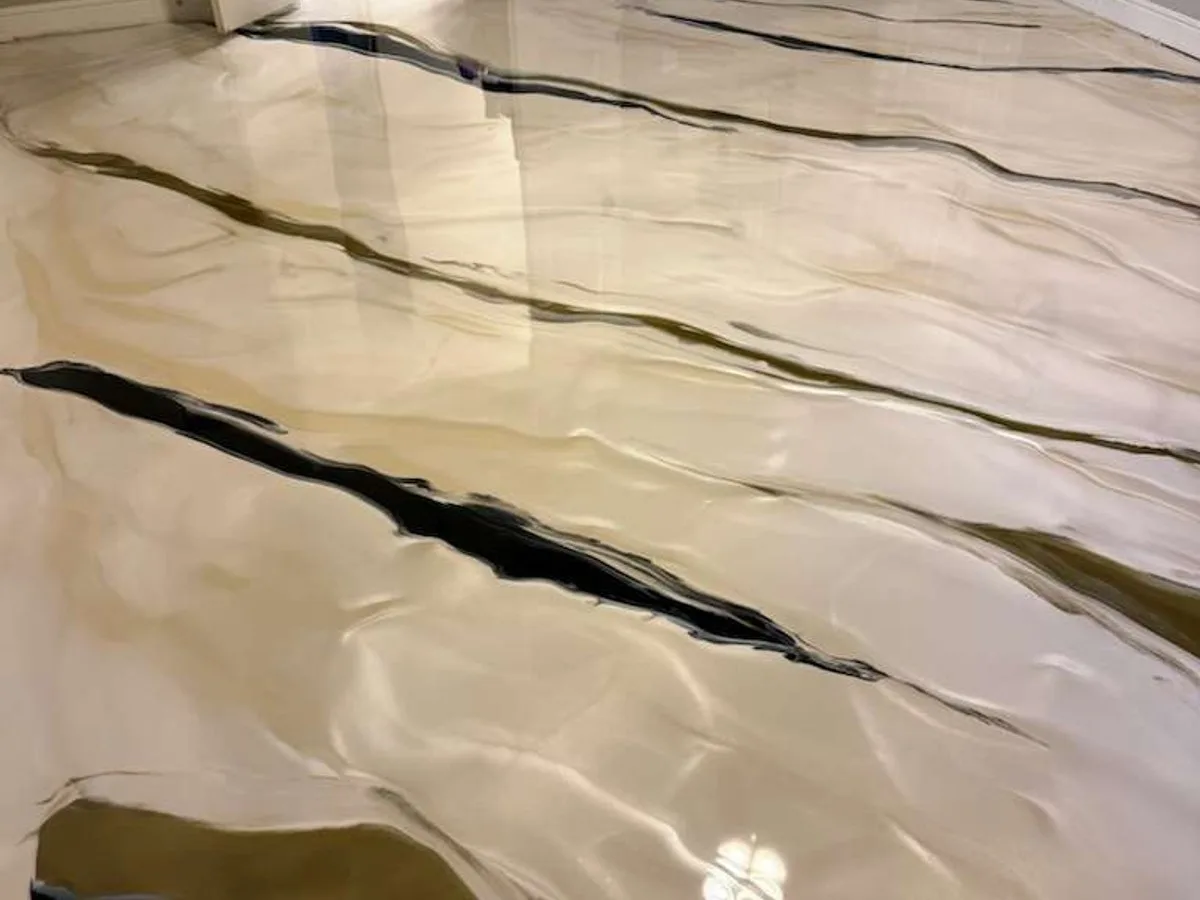
Metallic Epoxy
If you want a floor that looks like art (marble swirls, metallic sheen, 3D depth), this is the system. A pigmented metallic epoxy base creates a one-of-a-kind pattern; no two metallic floors look alike. Popular in show garages, home gyms, man caves, and luxury residential.
Not sure which finish? Speckled is what 8 in 10 Houston garages get. It hides everything and it’s the most affordable. Solid color is the showroom look. Marbled is the statement floor. All three get the same prep, the same epoxy primer, the same polyaspartic topcoat, and the same 15-year written warranty.
03 · Compare
All three finishes vs. the alternatives.
Every HFC system compared to DIY epoxy paint and bare concrete. Use this to figure out where you want to land on bond depth, install time, and price.
| Feature | 2-Day Hybrid | Solid Color | Metallic Epoxy | DIY Epoxy Paint |
|---|---|---|---|---|
| Base coat | 100% solids epoxy (overnight cure) | 100% solids epoxy (no flake) | Pigmented metallic epoxy | Water-based epoxy paint |
| Topcoat | Polyaspartic (UV-stable) | Polyaspartic (UV-stable) | Polyaspartic (UV-stable) | None |
| Install time | 2 days | 3–4 days | 2–3 days | 1–2 days (DIY) |
| Primer bond depth | Deepest (full overnight cross-link) | Strong (overnight cross-link) | Deepest | Minimal |
| UV stability | Yes. No yellowing | Yes. No yellowing | Yes. No yellowing | Yellows in 1–2 years |
| Hot-tire resistance | Yes | Yes | Yes | Peels within months |
| Chemical resistance | Excellent | High | Excellent | Poor |
| Decorative finish | Flake (16 blends) | Solid color (no flake) | Metallic swirl / marble | Solid color only |
| Warranty | 15-year installation | 15-year installation | 15-year installation | None |
| Expected service life | 15+ years | 15+ years | 15+ years | 2–5 years |
| Starting price | Flat by size | Flat by size | Flat by size | $1–2/sq ft (fails) |
04 · Alternatives
Garage floor coating vs. paint, tile, sealer, and DIY kits.
Before you decide on a coating system, here’s the honest case for and against the alternatives. We’d rather you understand the trade-offs than have regret either direction.
Garage floor paint
What it is: A water-based epoxy or acrylic “paint” sold at home improvement stores. Applied like house paint: roller, minimal prep, no grinding.
The problem: Water-based epoxy has poor adhesion to concrete without mechanical grinding. It yellows in UV exposure and lifts under hot tires within months in Houston’s summer heat. Almost every “garage floor paint” failure we’re called to fix is one of these products. The install is fast; the failure is faster.
When to consider it: If you’re renting or moving within 2–3 years and want temporary coverage. Just know what you’re getting.
Interlocking garage floor tile
What it is: PVC or polypropylene interlocking tiles or mats laid on top of concrete. No adhesion. Fully removable.
The problem: Houston humidity causes mold and mildew under tiles when moisture gets in from a wet car or any flooding. Joints trap debris. Tiles shift under heavy equipment and look like tiles on top of a floor, not a finished floor.
When to consider it: If you need a renter-friendly, zero-commitment option or an area that floods. For a permanent garage, a coating system is a better investment every time.
Concrete sealer
What it is: A penetrating or topical sealer applied to bare or stained concrete. Closes the pores without adding a significant decorative finish layer.
The problem: Sealers don’t add meaningful hardness or chemical resistance. They protect against moisture and staining but offer no resistance to hot tires, no anti-slip texture, and no substantial decorative upgrade. They need reapplication every 2–5 years.
When to consider it: If you have polished or stained concrete you’re maintaining, a penetrating sealer is the correct maintenance product. For a new garage project from bare concrete, it’s the wrong tool.
DIY epoxy kits
What it is: Big-box store epoxy kits (water-based epoxy paint, paint chips, sometimes a topcoat) packaged as a weekend project.
The problem: Failure rates on DIY epoxy kits in Houston are extremely high, not because people can’t follow directions, but because kits skip the steps that matter: diamond grinding, moisture testing, and 100% solids epoxy chemistry. Without diamond grinding, the epoxy can’t bond properly. In Houston’s climate, most kits peel within 12–24 months.
When to consider it: If you have a covered basement or shaded parking structure with low moisture, low traffic, and zero direct sun. In those conditions, some kits hold up acceptably.
05 · How we prep
The prep process is the same on every job.
Regardless of which system you choose, the floor prep that goes down before any coating is identical. This is where most installers cut corners. We don’t.
Slab Evaluation
We inspect the concrete for age, previous coatings, cracks, spalling, oil contamination, and moisture intrusion. If the slab has pre-existing issues that would compromise the install, we tell you before we start, not after.
Moisture Testing
We moisture-test the slab before any coating goes down. Houston’s clay soil and water table make moisture vapor transmission a real concern. High readings mean we treat before we coat. Skipping this step is the #1 cause of coating failure in humid climates.
Diamond Grinding
No acid wash. Diamond grinders prepare the surface to a CSP 2–3 profile: the mechanical roughness that lets epoxy physically lock into the concrete. No chemical etch achieves this consistently. The profile is what makes the coating mechanically impossible to peel off a properly prepped slab.
Crack & Divot Repair
Every crack, divot, and control joint is chased, cleaned, and filled before primer goes down. In Houston’s expansive clay soils, slab cracks are common. We address them before the coating, not after.
Apply Your System
Once the slab is prepped, we apply your chosen system per its specific installation protocol. The prep is identical across all three finishes. The product changes; the standard doesn’t.
06 · Pricing
What garage floor coatings cost in Houston.
Flat price by garage size
For a 2-car garage in speckled, complete. Solid color and marbled are priced the same way: flat, by garage size. Above 750 sq ft we price per square foot: $5.50 speckled, $7.00 solid color, $10.00 marbled.
The finish you pick and the condition of your slab are what move the number. Get a flat price on your exact garage in about a minute.
- Speckled (2-Day Hybrid): standard-cure epoxy, deepest bond
- Solid Color: one clean color, no flake, three coats
- Above 750 sq ft, priced per square foot: $5.50 speckled, $7.00 solid color, $10.00 marbled
- Marbled (Metallic Epoxy): premium decorative finish
- Every finish includes diamond grinding, moisture testing, and crack repair
- 15-year installation warranty in writing on every system
07 · FAQ
Garage floor coating questions we hear most.
What is the best garage floor coating?
For most Houston homeowners, the 2-day epoxy hybrid is the best overall system. It provides the deepest primer bond, full-refusal decorative flake, UV-stable polyaspartic topcoat, and a 15-year installation warranty at the lowest price of the three. If you want one clean color with a showroom look, solid color. If you want a statement floor, marbled. Every finish gets the same prep and the same overnight cure before the topcoat. We don’t sell a one-day floor.
How much does a garage floor coating cost in Houston?
Priced flat by garage size, in all three finishes: complete, with grind, prep, materials, labor, and the 15-year written warranty. Run the free estimator for a ballpark on your specific garage in 2 minutes.
How long does a garage floor coating last?
15+ years in residential use with proper installation. We back every system with a 15-year installation warranty in writing. The caveat: longevity depends almost entirely on prep quality. A properly diamond-ground, moisture-tested slab with a 100% solids epoxy primer will hold a coating for decades. An unprepped or acid-etched slab often fails within 1–3 years regardless of the coating product.
Can you coat a garage floor in 1 day?
No. Be careful with anyone who says yes. The base coat has to cure overnight before the topcoat goes on; that overnight cross-link is what bonds the floor to the slab. A one-day floor is one thin coat over concrete that’s still gassing off. Ours is two days on site for speckled, three to four for solid color and marbled, and you’re driving on it on day five.
Is epoxy or polyaspartic better for a garage floor?
Both, in their respective roles. Epoxy excels as a base/primer coat: it bonds to concrete at over 400 psi and creates a foundation the topcoat can’t pull off. Polyaspartic excels as a topcoat: it’s UV-stable (epoxy yellows under UV), fast-curing, and extremely hard. That’s why our hybrid (epoxy base, polyaspartic topcoat) outperforms either product used alone. Polyaspartic-only makes sense when you need maximum chemical resistance and fastest return-to-service.
Will the coating hold up to hot tires?
Yes. All three of our finishes are hot-tire resistant. Hot-tire pickup (coating lifting under warm tires) is almost always caused by inadequate surface prep or water-based epoxy paint. A properly diamond-ground slab with a 100% solids epoxy primer bonded at over 400 psi and sealed with polyaspartic is mechanically stronger than a tire can pull. The prep is what makes the coating hot-tire proof, not the product brand.
How long after coating before I can park on it?
Walk on it in 24 hours after the final topcoat. Light vehicle traffic at 48–72 hours. Full daily parking with hot tires at 7 days of full cure. We give you specific timeline instructions at walk-through. Parking too early in Houston summer heat can leave impressions. Follow the cure window.
Does the prep need to be done before coating?
Yes, and the prep is the most important part of the entire job. Diamond grinding to a CSP 2–3 profile is required. It’s not optional or replaceable with acid etch. In Houston, moisture testing before coating is equally critical: moisture vapor rising through the slab is the #1 cause of coating failure in humid climates. We do both on every single job before any product goes down.
Can you coat over an existing garage floor coating?
Sometimes, but only after evaluation. We test the existing coating’s adhesion and check for delamination. If it passes adhesion testing, we can often coat over it. If it’s peeling, lifting, or failing, we remove it first. Coating over a failing surface is one of the fastest ways to create a new failure.
Do you repair cracks before applying the coating?
Yes. Crack repair is included in every job. We chase every visible crack, fill it with appropriate repair material, and let it cure before the primer goes down. Minor cosmetic cracks are invisible under a flake system. Structural or actively moving cracks get documented and discussed before we start. No coating system prevents an actively moving crack from re-appearing, and we’ll tell you that upfront.
What flake colors do you offer?
We stock 12 standard vinyl flake blends and 4 premium marble flakes. That’s 16 total. Options include neutral blends (Gravel, Nightfall, Cobalt), warm tones (Cabin Fever, Coyote, Creekbed), bold options (Tidal Wave, Orbit), and premium marble-look flakes (Basalt, Lanai Gray, Pumice). See all 16 flake options. Custom blends available for larger projects.
Do you serve areas outside of Houston proper?
Yes. We install across greater Houston including Katy, Sugar Land, The Woodlands, Cypress, Pearland, Spring, Friendswood, League City, Kingwood, Memorial, River Oaks, the Houston Heights, Humble, Missouri City, Pasadena, and Galveston. See the full service area list below.
08 · Service area
Garage floor coatings across greater Houston.
Ready to choose your system?
Run the free estimator to get a ballpark on your garage in 2 minutes. On-site estimates are $50, credited to your project if you book.