

Comparison · 2026
Hybrid Epoxy vs 1-Day Garage Floor: Which Should You Pick?
Both are real 3-layer systems. Both use polyaspartic topcoat. Both carry our 15-year warranty. The honest side-by-side from a contractor who installs both — with ASTM-spec'd numbers and real Houston pricing.
The short answer
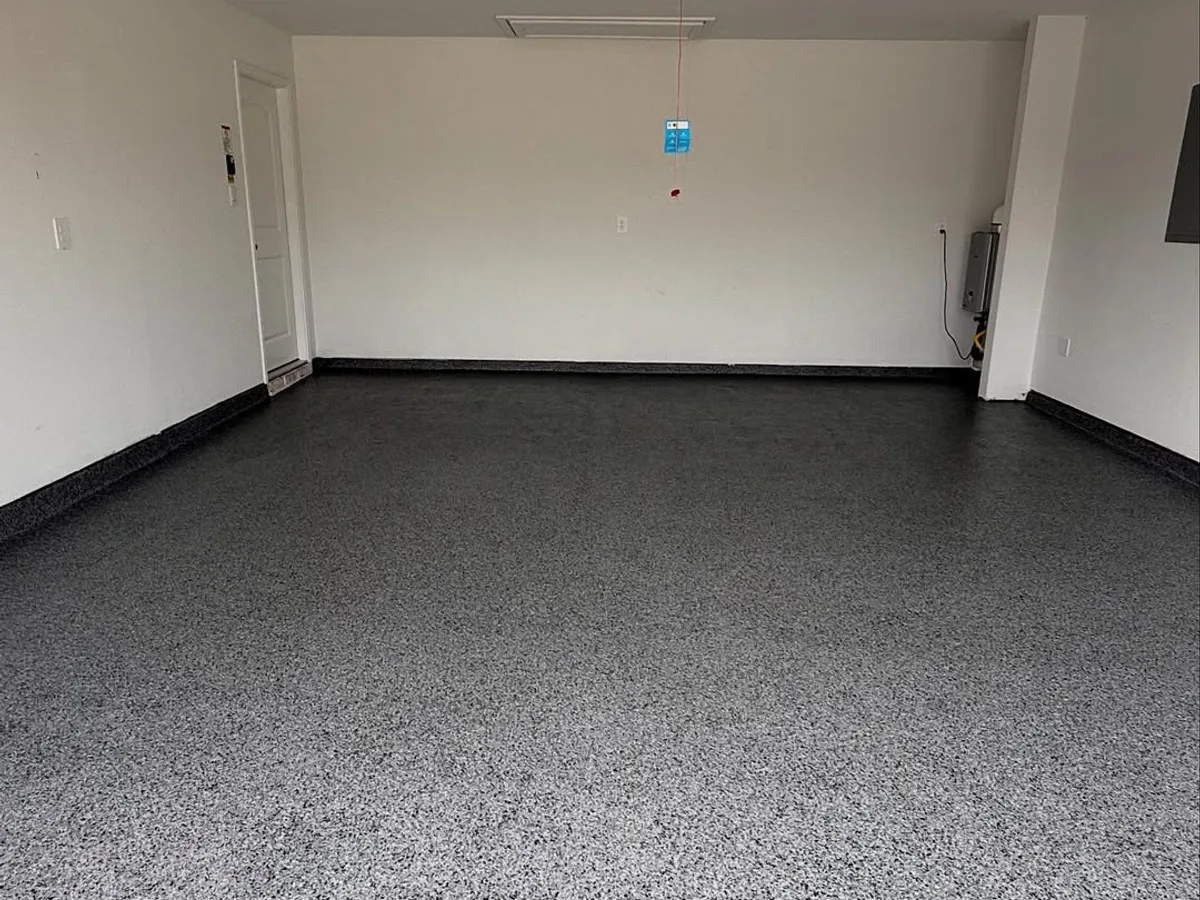
Same full-refusal flake. Same polyaspartic topcoat. Same 15-year installation warranty. The one real difference: the epoxy primer. Hybrid uses standard-cure epoxy that fully cross-links overnight before the topcoat — deepest primer bond we build. 1-day uses fast-cure epoxy topcoated the same day; fast-cure chemistry can’t reach standard-cure’s cross-link density in the install window, so the bond is genuinely shallower. For typical residential use the field performance is indistinguishable. For heavy commercial / shop wear, hybrid has the edge. Pick the one that matches your timeline (and heavy-use profile). Price: hybrid $5/sq ft, 1-day $6.50/sq ft.
01 · Start here
First, what’s the same between both HFC systems.
A lot, actually. Most of the choice is about the one thing that differs.
- Same prep standard. Diamond-ground to CSP 2–3 (ICRI 310.2), moisture-tested, crack-chased. We don’t shortcut prep on 1-day jobs.
- Same full-refusal flake. Both systems broadcast vinyl flake to full refusal. All 16 blends (12 standard + 4 premium marble) available on both.
- Same topcoat. Aliphatic polyaspartic, 4–6 mils DFT, UV-stable per ASTM G154, chemical-resistant. Identical product on both systems.
- Same 15-year installation warranty. In writing, covering adhesion failure, blistering, and topcoat failure under normal use. No warranty penalty for choosing 1-day.
- Same cure windows. Walk on either floor 24 hours after the topcoat. Drive on either at 72 hours.
- Same crew caliber. We hand-pick and vet every install team; the same crews run both systems.
The one real difference is the primer’s bond depth. Hybrid uses standard-cure epoxy that fully cross-links overnight — by the time the topcoat goes on, the primer has reached its maximum bond strength. 1-day uses fast-cure epoxy topcoated the same day; fast-cure chemistry can’t reach standard-cure’s cross-link density in the install window, so the primer bond is genuinely shallower. Both are real epoxy primers (not the polyurea or poly-only shortcut most franchise 1-day systems use), but the hybrid gets the deeper bond by virtue of the overnight cure.
02 · Anatomy
How each system is actually built.
2-Day Epoxy Hybrid
1-Day Fast-Cure
03 · Side-by-side
The full comparison table.
Every cell is a real-world number, not a marketing claim. Lifespan numbers assume proper prep — on a poorly prepped slab, any coating fails early.
| Dimension | 2-Day Hybrid | 1-Day Fast-Cure |
|---|---|---|
| Install time on-site | 2 days (~16 hrs) | 1 day (~10 hrs) |
| Walk-on time | 24 hr after topcoat | 24 hr after topcoat |
| Vehicle return | 72 hr | 72 hr |
| Base coat type | Standard-cure 100% solids epoxy | Fast-cure 100% solids epoxy |
| Base coat DFT | 8–12 mils | 8–12 mils (same) |
| Primer cross-link at topcoat time | Full (overnight cure) | Partial (4-hr recoat window) |
| Primer bond to concrete | Deepest we build | Shallower — real chemistry trade-off of fast-cure |
| Flake load | Full-refusal broadcast | Full-refusal broadcast (same) |
| Topcoat | Aliphatic polyaspartic (4–6 mils) | Aliphatic polyaspartic (4–6 mils — identical) |
| UV stability (ASTM G154) | Non-yellowing at 1,000 hrs | Non-yellowing at 1,000 hrs (same topcoat) |
| Chemical resistance | Excellent (gas, oil, brake fluid) | Excellent (same topcoat) |
| Abrasion (ASTM D4060 CS-17) | <60 mg / 1,000 cycles | <60 mg / 1,000 cycles |
| Hot-tire pickup resistance | Excellent | Excellent |
| Residential field performance | Indistinguishable from 1-day | Indistinguishable from hybrid |
| Heavy shop/commercial performance | Edge under heavy load | Still excellent, hybrid has edge |
| HFC warranty | 15 years in writing | 15 years in writing (same) |
| Houston starting rate | $5/sq ft | $6.50/sq ft |
04 · Decision
Which one should you actually pick?
Neither system is universally better. They’re built for different constraints.
Option A
Pick the 2-Day Hybrid
When you can spare two days and want the deepest primer bond we build.
- You can spare two days without the garage
- You want the deepest primer bond — standard-cure epoxy fully cross-links before the topcoat
- Heavy shop use, multiple vehicles, or commercial wear (the hybrid’s primer has the edge there)
- You want to save $1.50/sq ft (fast-cure epoxy costs more per gallon)
- Same full-refusal flake, same topcoat, same 15-year warranty as the 1-day — primer bond depth is the only real difference
Option B
Pick the 1-Day Fast-Cure
When schedule matters most — without trading to a polyurea shortcut.
- You can’t spare two days without the garage
- Rental property turnover or narrow commercial shutdown window
- You’re fine paying $1.50/sq ft more for a same-day install
- You want a real epoxy primer (not a polyurea-primer shortcut) even knowing fast-cure reaches a shallower bond
- Space is under ~1,500 sq ft (larger jobs may need split schedule)
05 · Common misconception
The “polyaspartic vs epoxy” myth.
You’ll see a lot of online content framing “polyaspartic vs epoxy” as a binary — as if you’re picking one or the other.
That framing is mostly a marketing artifact from franchise 1-day coaters who sell a single-product polyaspartic system and need to position it against traditional epoxy. In reality:
Polyaspartic is a better topcoat than epoxy. It’s UV-stable (epoxy yellows), it cures faster (epoxy takes longer), and it has better abrasion resistance at similar DFT.
Epoxy is a better base coat than polyaspartic. Its bond to concrete is stronger (higher adhesion values on ASTM D4541), it wets concrete better during application, and it tolerates Houston’s slab moisture variability more forgivingly.
A real hybrid system uses both, in the roles each is best at. That’s exactly what both our 2-day and our 1-day systems do — epoxy base, polyaspartic topcoat. Neither is “winning over” the other; they’re working together.
| Role | Epoxy | Polyaspartic |
|---|---|---|
| Bond to concrete | Stronger | Weaker |
| UV stability | Yellows over time | Non-yellowing |
| Cure speed | Slower | Faster |
| Abrasion resistance | Good | Better |
| Moisture tolerance | Better | Sensitive |
| Pot life | Long (40+ min) | Short (15–30 min) |
| Best role | Base coat | Topcoat |
06 · Cost
Which one actually costs more?
Counterintuitively, 1-day is slightly more expensive than hybrid. The fast-cure epoxy product costs more per gallon, and that shows up at the rate level.
| System | Starting rate | Example: 500 sq ft 2-car |
|---|---|---|
| 2-day hybrid | $5/sq ft | Starts at $2,500 (min $1,500) |
| 1-day fast-cure | $6.50/sq ft | Starts at $3,250 |
The $1,500 project minimum applies to both systems regardless of square footage. Final pricing depends on slab condition, square footage, and flake choice.
07 · Polyurea detour
What about polyurea? Isn’t it even better?
Polyurea is available on request. For 95% of Houston garages, polyaspartic is the better default.
Polyurea cures faster than polyaspartic — sometimes in seconds. That’s useful for extreme applications (sub-freezing cure, persistent chemical exposure). But most polyurea formulations are less UV-stable than polyaspartic, and their very short pot life makes them harder to apply evenly by hand. For a sun-exposed Houston garage, polyaspartic is the stronger default.
Where polyurea wins: home mechanic shops with persistent heavy chemicals, commercial brewery floors, environments with motor oil or brake fluid pooling. If that describes your space, ask us on the estimate — we scope polyurea builds on request.
Both our 2-day hybrid and our 1-day system use polyaspartic topcoat by default. That’s the right call for the Houston residential garage.
08 · FAQ
Hybrid vs 1-day questions.
Is polyaspartic better than epoxy?
Different roles, different answers. Polyaspartic is a better topcoat (UV, abrasion, speed). Epoxy is a better base coat (bond strength, moisture tolerance). The best floor systems use both — which is exactly what our hybrid and 1-day systems do.
Can you apply polyaspartic over epoxy?
That’s literally what a hybrid garage floor is. Both our 2-day and 1-day systems apply polyaspartic topcoat over an epoxy base. It’s the standard approach in professional installs.
How long does polyaspartic last compared to epoxy?
As a topcoat, polyaspartic outlasts an epoxy topcoat (UV stability + harder wear surface). As a standalone single-product floor (polyaspartic-only), it underperforms a proper hybrid because of weaker concrete adhesion. Answer depends on the role and the full system.
What’s the disadvantage of polyaspartic?
Cost (more expensive than epoxy), short pot life (15–30 minutes requires experienced installers), and weaker bond to concrete than epoxy. All three are mitigated by using it as a topcoat over epoxy rather than as a standalone single-product system.
Can I upgrade my 1-day floor to a hybrid later?
Only by grinding the existing 1-day system off and starting over. Coating over an existing floor is only as durable as the weakest layer. If you’re unsure between the two, pick the hybrid now rather than plan to upgrade later.
Which system do you install more of in Houston?
Hybrid — by a wide margin. Most homeowners are willing to lose the garage for 2 days for the deeper primer bond + the $1.50/sq ft price break. 1-day is a small but real segment: rental owners, small commercial spaces, and homeowners with scheduling constraints who want a real epoxy primer rather than a polyurea-primer franchise system.
Same 15-year warranty on both?
Yes. Same terms, same length, same written coverage on both hybrid and 1-day installs. The shallower primer bond on 1-day is a real chemistry trade-off of fast-cure products, but we’ve still seen the system hold under warranty for the residential garages it’s designed for.
Is polyurea really that different from polyaspartic?
Similar chemistry family (polyurethane-based), different cure profiles and UV behavior. Polyurea cures faster but is less UV-stable in most formulations. Polyaspartic is the better default for residential garages. Polyurea on request for specialty jobs.
Still deciding? Run the estimate for both.
The free online estimator gives you a 2-minute ballpark on all four systems — hybrid, 1-day, polyaspartic, and metallic. See them all priced for your exact square footage.